
Machine or mystery
Someone had to decide the Moon was not dangerous. It was a committee, and it took three missions.
Lunar quarantine was not lifted by a discovery but by a decision. An Interagency Committee on Back Contamination, formed in 1966 from NASA, the US Public Health Service, the Department of Agriculture and academia, held the authority; it released the Apollo 11 crew after a 21-day observation period, and in early 1970 concluded that quarantine had become superfluous — while insisting the lunar samples themselves stay contained.
- Revision: 1
- Published: 2026-08-14
- Updated: 2026-08-14
- By: Space Now, edited by J. S. Nova
The object
Full frame first: the source before any crop, zoom or annotation.
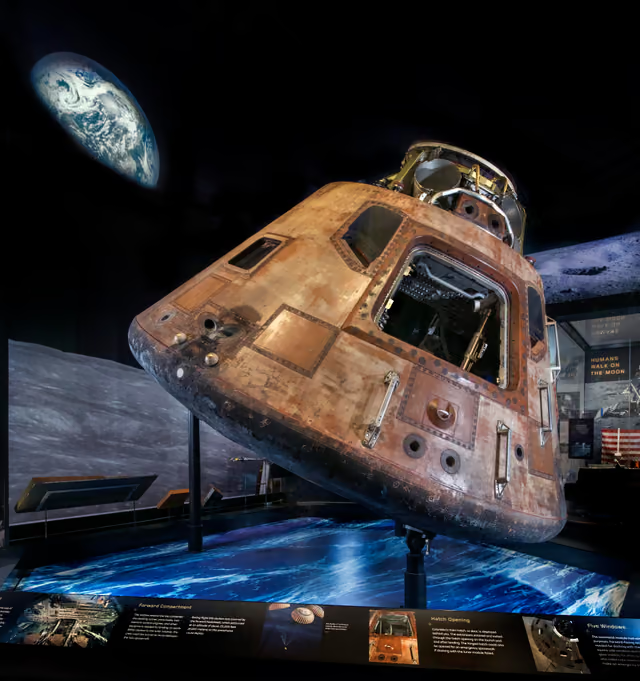
The same structure governs sample-return missions today: an outside body, not the flight programme, decides what counts as sufficient evidence of safety, and the samples remain contained long after the crew is released.
The question nobody could answer in advance
Before Apollo 11 there was no way to establish whether lunar material carried anything biologically active. Absence of evidence was the only evidence available, and it is not the same thing as evidence of absence. Rather than let the flight programme rule on its own risk, an Interagency Committee on Back Contamination was established in 1966 as the policy-making board for quarantine, drawing in the agencies responsible for public health and agriculture alongside NASA and academic members.
Authority delegated, not assumed
For Apollo 11 the committee designated a specific official — the Manned Spacecraft Center's Director of Medical Research and Operations — as the agent able to impose quarantine on the crew, the spacecraft and the returned lunar material at any phase of the mission, and authorised him to appoint people at each location who could exercise that authority. Quarantine was lifted from the crew and those isolated with them after a 21-day observation period, on the basis of medical and biological data gathered during it.
Retiring a precaution without abandoning it
Early in 1970, with results from two lunar landings in hand, the committee reviewed the requirement. Given what had been found on the Moon, crew quarantine now appeared superfluous, and after lengthy discussion the committee recommended to the NASA administrator that it be discontinued — while holding that biological examination of the samples and containment practice in the lunar receiving laboratory should continue. The precaution was narrowed to where uncertainty remained, and it was not narrowed all at once: quarantine stayed in force for Apollo 14, which was to take a deep core sample that might differ from surface material.
Chronology
Generated from dated relations, with the precision of each date stated.
- year precisionThe Interagency Committee on Back Contamination is established as the policy-making board on quarantine.
- month precisionThe committee lifts quarantine on the Apollo 11 crew after a 21-day observation period.
- year precisionThe committee recommends discontinuing crew quarantine while retaining containment of the samples.
Related records
explained by
Who held the authority to declare the Moon safe?
Confidence: high · 1969-08-10 (day precision)
supports
What was the Moon carried home inside?
Confidence: high · 1969-07-24 (day precision)
follows
What happened to the crew after the cameras stopped?
Confidence: high · 1969-08-10 (day precision)
Inspect the record2 assertions, each with its source
Every assertion, its source class, and any conflict or uncertainty in the record.
An Interagency Committee on Back Contamination, established in 1966, was the policy-making board on quarantine, comprising NASA, the US Public Health Service, the Department of Agriculture and academia; for Apollo 11 it designated the MSC Director of Medical Research and Operations as the agent able to impose quarantine on crew, spacecraft and returned lunar material.
Source class: space agency historyNASA SP-4214 — Complexities of QuarantineView the source
The committee lifted quarantine on the Apollo 11 crew after a 21-day observation period based on medical and biological data; early in 1970 it reviewed the requirement, found crew quarantine superfluous and recommended discontinuing it while continuing biological examination and containment of lunar samples. Quarantine remained in force for Apollo 14, which was to take a deep lunar core sample.
Source class: space agency historyNASA SP-4214 — Where No Man Has Gone Before, ch. 12-9View the source
CorrectionsNone recorded
No corrections recordedThis record has not been corrected since it was published.