
Current lineage
The first men back from the Moon were handed protective suits before they were allowed out of the capsule
Apollo 11's recovery was not a rescue but a containment operation. Navy swimmers stabilised the capsule, a decontamination officer passed protective garments in through the hatch, the crew put them on before emerging, and they went straight into a sealed trailer on the carrier deck — because nobody could yet prove the Moon carried nothing harmful.
- Revision: 1
- Published: 2026-08-14
- Updated: 2026-08-14
- By: Space Now, edited by J. S. Nova
The object
Full frame first: the source before any crop, zoom or annotation.
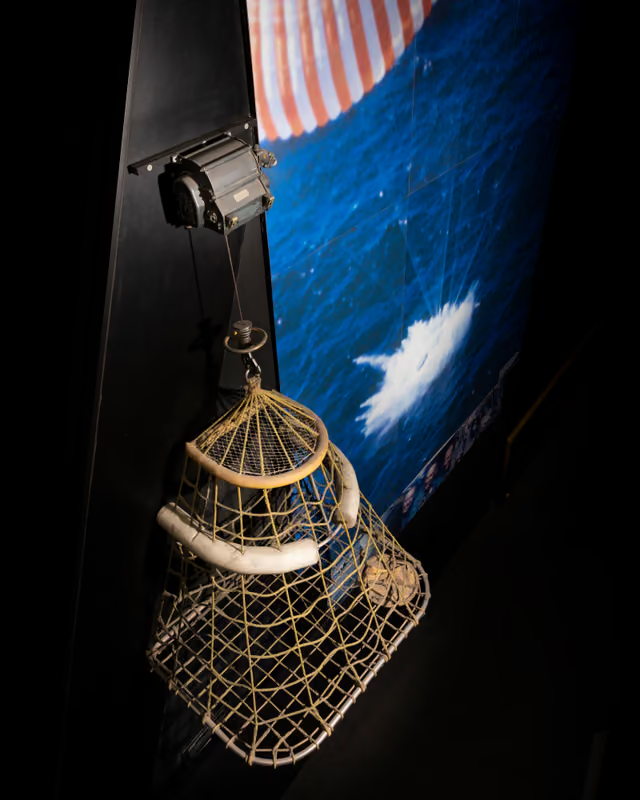
Recovery is still the least-discussed and most choreographed part of a crewed flight. Ships, swimmers and helicopters are positioned before launch, and the crew's first minutes back are run by people who trained for them for weeks.
Stabilise first
The immediate danger after splashdown is not contamination but the sea. The first swimmer in the water, John M. Wolfram, attached a sea anchor to the spacecraft to steady it in rough conditions. Two more swimmers, Wesley T. Chesser and Michael G. Mallory, then joined him and the three of them fitted a flotation collar around the capsule so it would sit upright and high enough in the water to be opened safely.
The suits went in before the crew came out
A helicopter lowered Biological Isolation Garments for the crew and for Clarence J. 'Clancy' Hatleberg, the decontamination officer, along with canisters of decontamination solution for both the astronauts and the capsule. The BIG was a heavy-duty protective suit: a nylon jumpsuit covering the body completely, with an integrated mask that filtered the wearer's exhaled air. All the swimmers wore scuba gear to minimise exposure to any possible lunar microorganisms.
A trailer on a carrier deck
Once aboard USS Hornet the crew went into a Mobile Quarantine Facility — a converted Airstream trailer of about 280 square feet with a bathroom, shower, galley and bunks — and stayed in it while the ship carried them toward a larger quarantine facility in Houston. The precaution was not a prediction that lunar pathogens existed. It was an admission that nobody could yet rule them out, and that the cost of being wrong was unbounded.
Chronology
Generated from dated relations, with the precision of each date stated.
- day precisionApollo 11 splashes down and is recovered by USS Hornet; the crew enter the Mobile Quarantine Facility.
Related records
explained by
Who reached the returning crew first, and what were they carrying?
Confidence: high · 1969-07-24 (day precision)
follows
What happened to the crew after the cameras stopped?
Confidence: high · 1969-08-10 (day precision)
relates to
What the recovery was actually protecting.
Confidence: high · 1969-07-24 (day precision)
Inspect the record2 assertions, each with its source
Every assertion, its source class, and any conflict or uncertainty in the record.
John M. Wolfram attached a sea anchor to stabilise the spacecraft; Wesley T. Chesser and Michael G. Mallory joined him to attach a flotation collar; decontamination officer Clarence J. Hatleberg received Biological Isolation Garments and decontamination solution lowered by helicopter, and all swimmers wore scuba gear to limit exposure to possible lunar microorganisms.
Source class: space agency recordNASA — 50 Years Ago: Hornet + 3, The Recovery of Apollo 11View the source
The crew were sequestered in a converted Airstream trailer, the Mobile Quarantine Facility, of about 280 square feet with bathroom, shower, galley and bunks, in which they travelled toward a larger quarantine facility in Houston.
Source class: space agency recordNASA Science — A BIG Moment for Apollo 11View the source
CorrectionsNone recorded
No corrections recordedThis record has not been corrected since it was published.