
Current lineage
Japan's cargo ship did not dock with the space station. It stopped nearby and waited to be caught.
Japan's KOUNOTORI resupply craft approached the International Space Station and then held station while the robotic arm reached out, grappled it, and berthed it by hand. That capture-and-berth technique became the standard method for arriving at the station — including for the American commercial vehicles that followed.
- Revision: 1
- Published: 2026-08-14
- Updated: 2026-08-14
- By: Space Now, edited by J. S. Nova
The object
Full frame first: the source before any crop, zoom or annotation.
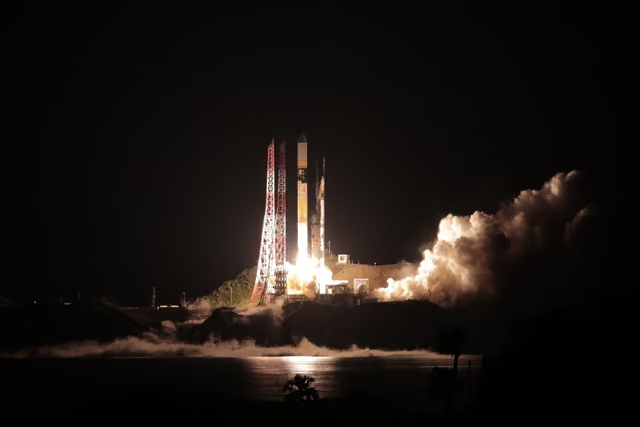
When a Cygnus or a Dragon is grappled by the arm rather than docking under its own control, it is using the arrival technique Japan's cargo vehicle established.
Two ways to arrive
A spacecraft can dock — fly itself into a mating ring under its own guidance, with all the risk that carries near a crewed station — or it can be berthed: stop at a safe distance, hold position precisely, and let the station's robotic arm capture it and move it to a port. Berthing puts the final, most dangerous metres under the control of the crew and the arm rather than the visiting vehicle's autopilot, and it allows a much larger hatch, which is what lets big payloads through.
What KOUNOTORI carried, and why the big hatch mattered
The vehicle was designed to deliver up to six tons of supplies — food, clothing, experiment equipment — to a station orbiting around 400 kilometres up, and to depart loaded with waste. Its distinguishing capability was bulk: it could carry multiple large pieces of experimental equipment, and station batteries, on a single flight. That is only possible through a berthing port, and berthing is only possible if the vehicle can hold still and be caught.
The technique outlived the vehicle
Japan also had to build the conversation that makes the approach safe: the Kibo module carries a Proximity Communication System, developed for KOUNOTORI, letting the resupply vehicle and the station talk directly to each other rather than through the ground. The approach method it proved — grapple with the arm, then berth — became the standard for reaching the ISS, adopted by privately developed American supply craft including Cygnus and Dragon.
Chronology
Generated from dated relations, with the precision of each date stated.
- year precisionThe first KOUNOTORI reaches the ISS and is captured and berthed by the station's robotic arm.
- year precisionThe KOUNOTORI series concludes, its capture-and-berth approach having become the standard for ISS resupply.
Related records
compared with
How does a spacecraft arrive somewhere safely — by flying in, or by being caught?
Confidence: high · 2009-09-10 (day precision)
relates to
Both are about who is allowed to approve an approach.
Confidence: high · 2009-01-01 (year precision)
relates to
Contributions from outside the American programme.
Confidence: high · 2009-01-01 (year precision)
relates to
Infrastructure inherited, and technique inherited.
Confidence: high · 2009-01-01 (year precision)
Inspect the record2 assertions, each with its source
Every assertion, its source class, and any conflict or uncertainty in the record.
The station's robotic arm grapples the HTV and berths it; this capture-and-berthing technique became the standard for approaching the ISS, used even by privately developed US supply craft such as Cygnus and Dragon. Kibo carries a Proximity Communication System developed by Japan so the vehicle and station can communicate directly.
Source class: space agency recordJAXA — H-II Transfer Vehicle KOUNOTORI (HTV) overviewView the source
KOUNOTORI was designed to deliver up to six tons of supplies to the ISS at an altitude of about 400 kilometres and to return with waste, and could carry multiple large pieces of experimental equipment and station batteries on a single mission.
Source class: space agency recordJAXA — History of KOUNOTORI (HTV)View the source
CorrectionsNone recorded
No corrections recordedThis record has not been corrected since it was published.