
Machine or mystery
America's first space station was wrecked 63 seconds after launch. They fixed it with an umbrella.
Skylab's combined micrometeoroid and thermal shield tore away barely a minute into its launch in May 1973, taking one solar array with it and jamming another, and the unshaded station heated to the point of being uninhabitable. Rather than write it off, engineers designed a sunshade that could be pushed out through a small scientific airlock like a parasol, and the first crew flew up eleven days later and deployed it.
- Revision: 1
- Published: 2026-08-14
- Updated: 2026-08-14
- By: Space Now, edited by J. S. Nova
The object
Full frame first: the source before any crop, zoom or annotation.
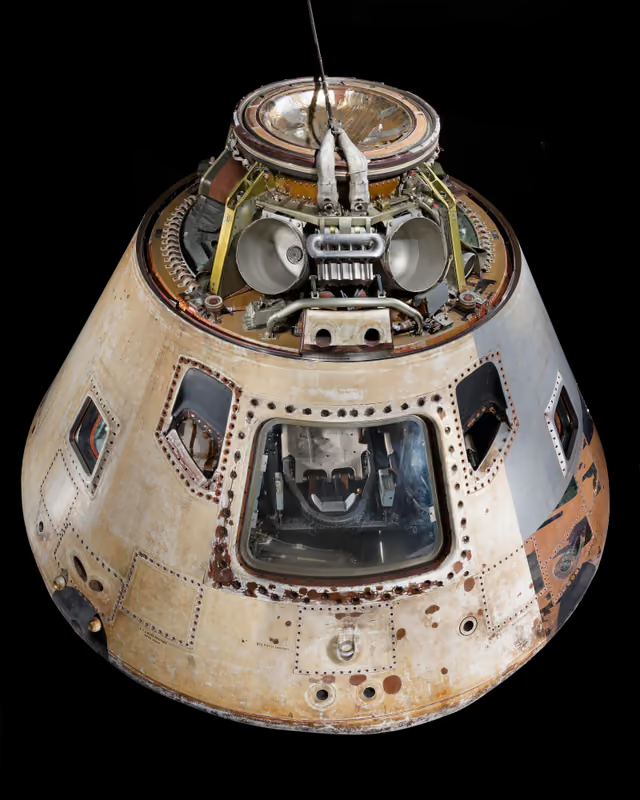
It is the origin of a habit that still governs crewed programmes: assume the vehicle will arrive damaged, and carry the ability to repair it. Every station spacewalk toolkit descends from the eleven days when Marshall Space Flight Center had to invent one.
One component, two jobs, both lost
The shield wrapped around the workshop was doing double duty — stopping micrometeoroids and shading the hull from sunlight. Sixty-three seconds into the flight it deployed prematurely, and the airstream tore it off the vehicle. Debris from it fouled the solar arrays: one wing was jammed, the other was lost entirely. The station reached orbit short of power and with nothing between its skin and the Sun.
An empty station cooking itself
Interior temperatures climbed until Skylab was uninhabitable, with the food, medicines, film and experiments already aboard at risk. When the crew did arrive they encountered temperatures around 130°F. The problem was unusually cruel because it worsened while nobody was there to do anything about it, and because the two failures compounded — less power to run cooling, more heat to remove.
Eleven days to invent a repair
At Marshall Space Flight Center engineers developed, tested, rehearsed and approved three options: a parasol sunshade, a twin-pole sunshade, and a set of metal cutting tools for the jammed array. The crew and the repair kits launched eleven days after the accident. They deployed the parasol out through a scientific airlock — a port designed for instruments, not for structural repair — and interior temperatures came down enough for the science programme to begin. A later spacewalk freed the jammed solar wing.
Chronology
Generated from dated relations, with the precision of each date stated.
- day precisionSkylab launches; 63 seconds in, the micrometeoroid and thermal shield tears away and the solar arrays are damaged.
- day precisionThe first crew launches with repair kits, eleven days after the accident.
Related records
explained by
How do you repair a space station that was wrecked before anyone arrived?
Confidence: high · 1973-05-14 (day precision)
relates to
Two orbital repairs, twenty years apart.
Confidence: high · 1990-04-24 (day precision)
Inspect the record2 assertions, each with its source
Every assertion, its source class, and any conflict or uncertainty in the record.
The micrometeoroid shield deployed prematurely 63 seconds into flight and aerodynamic forces tore it off, removing Skylab's thermal protection; debris jammed one solar array wing and the other was lost, leaving the station uninhabitable, with the crew later encountering 130°F.
Source class: space agency recordNASA — 50 Years Ago: Skylab 2, The "We Fix Anything" CrewView the source
Marshall Space Flight Center developed, tested, rehearsed and approved three repair options — a parasol sunshade, a twin-pole sunshade and metal cutting tools — and the crew launched with them eleven days after the incident, deploying the parasol through a scientific airlock to bring temperatures down.
Source class: space agency recordNASA — 50 Years Ago: Skylab 2, The "We Fix Anything" CrewView the source
CorrectionsNone recorded
No corrections recordedThis record has not been corrected since it was published.