
Current lineage
A launch pad is a machine, and it gets rebuilt for every rocket that uses it
A pad is not a parking space with a countdown clock; it is a purpose-built machine sized to one specific rocket's plumbing, exhaust, and hold-downs. When a different rocket takes over a pad, the structure is substantially demolished and rebuilt — the same patch of Florida concrete has now served Apollo's Saturn V, the Space Shuttle, and SpaceX's Falcon rockets, and none of them could have used the others' hardware unchanged.
- Revision: 1
- Published: 2026-08-14
- Updated: 2026-08-14
- By: Space Now, edited by J. S. Nova
The object
Full frame first: the source before any crop, zoom or annotation.
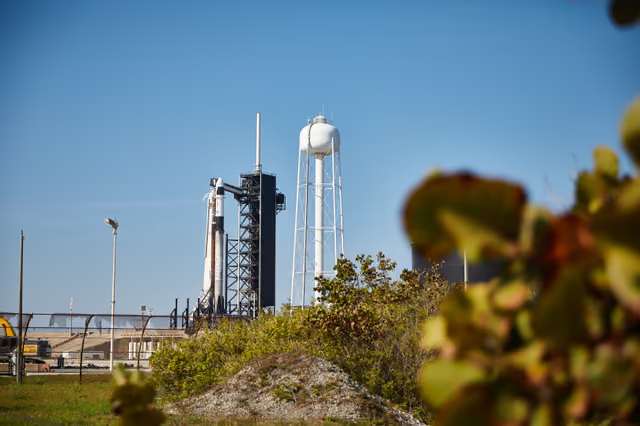
Launch Complex 39A is flying commercial crew missions today from the structure Apollo built. What survived is the location, the flame trench and the basic geometry — almost everything a rocket actually touches has been replaced twice.
What a pad actually has to do
A launch pad has to hold a fuelled rocket still, feed it propellant at enormous rates, keep it supplied with power and data until the last second, release it cleanly, and then survive the exhaust. Each of those jobs is dimensioned around a particular vehicle: the height of the umbilical connections, the diameter and routing of the propellant lines, the position of the hold-down points, the volume of water needed to absorb the acoustic energy of ignition. Change the rocket and every one of those numbers changes with it.
Three tenants, one address
NASA describes Launch Complex 39A plainly as the former Apollo/Saturn V and Space Shuttle pad, now set up to host Falcon 9 and Falcon Heavy. Each transition meant heavy construction rather than reconfiguration. Adapting the pad for the Falcon family required removing more than 500,000 pounds of steel from the structure — a quarter of a million kilograms of the previous tenant's launch tower cut away and taken off site before the new vehicle could use the place at all.
Why they rebuild instead of starting fresh
What makes a pad worth inheriting is everything that is not the steel: a site cleared and licensed for the hazard, a flame trench cut into the ground, roads able to carry a rocket, and a safety footprint already established with everyone who lives and flies nearby. Those are the slow, contested, expensive things. The tower is comparatively easy to replace, so the tower is what gets replaced. Crew Dragon missions now leave from the same coordinates that sent crews to the Moon, on hardware that shares almost nothing with them.
Chronology
Generated from dated relations, with the precision of each date stated.
- decade precisionLaunch Complex 39A is built for the Saturn V.
- year precisionNASA records the pad as modified for Falcon 9 and Falcon Heavy, with more than 500,000 pounds of steel removed from the structure.
Related records
worked on
Who was watching the instruments when the Saturn V left the pad?
Confidence: high · 1969-07-16 (day precision)
relates to
The pad and the engine were designed for each other.
Confidence: high · 1967-11-09 (day precision)
relates to
Infrastructure inherited, and technique inherited.
Confidence: high · 2009-01-01 (year precision)
Inspect the record1 assertion, each with its source
Every assertion, its source class, and any conflict or uncertainty in the record.
Launch Complex 39A, the former Apollo/Saturn V and Space Shuttle pad, was modified for Falcon 9 and Falcon Heavy by removing more than 500,000 pounds of steel from the structure; Crew Dragon also launches from it.
Source class: space agency recordNASA — LC-39A modified for future launchesView the source
CorrectionsNone recorded
No corrections recordedThis record has not been corrected since it was published.