

Weekly briefing archive
A rocket failed, a valve confessed, and Webb saw through the haze
China lost a Long March 7A mission, Blue Origin identified the part behind New Glenn’s test-stand explosion, and infrared astronomy delivered the clearest science result. The next few days belong to H3, an eclipse and a crowded Falcon 9 calendar.
This was a week of useful distinctions: a launch target became a failure, an investigation found a component, and a beautiful telescope image became an informative map.
The consequential failure came less than 90 seconds after a Long March 7A left Wenchang. Blue Origin, meanwhile, traced May’s New Glenn explosion to a liquid-oxygen valve, moving that investigation from mystery toward repair. Webb supplied the week’s unambiguous win by separating dusty structures from glowing gas in the Lion Nebula. Next, watch whether H3 converts its restored QZS-7 slot into a completed mission, whether Starlink 10-19 escapes its delay and what scientists learn from the Aug. 12 eclipse.
Lead stories
The developments that defined this week.
China’s launch surge acquired an asterisk
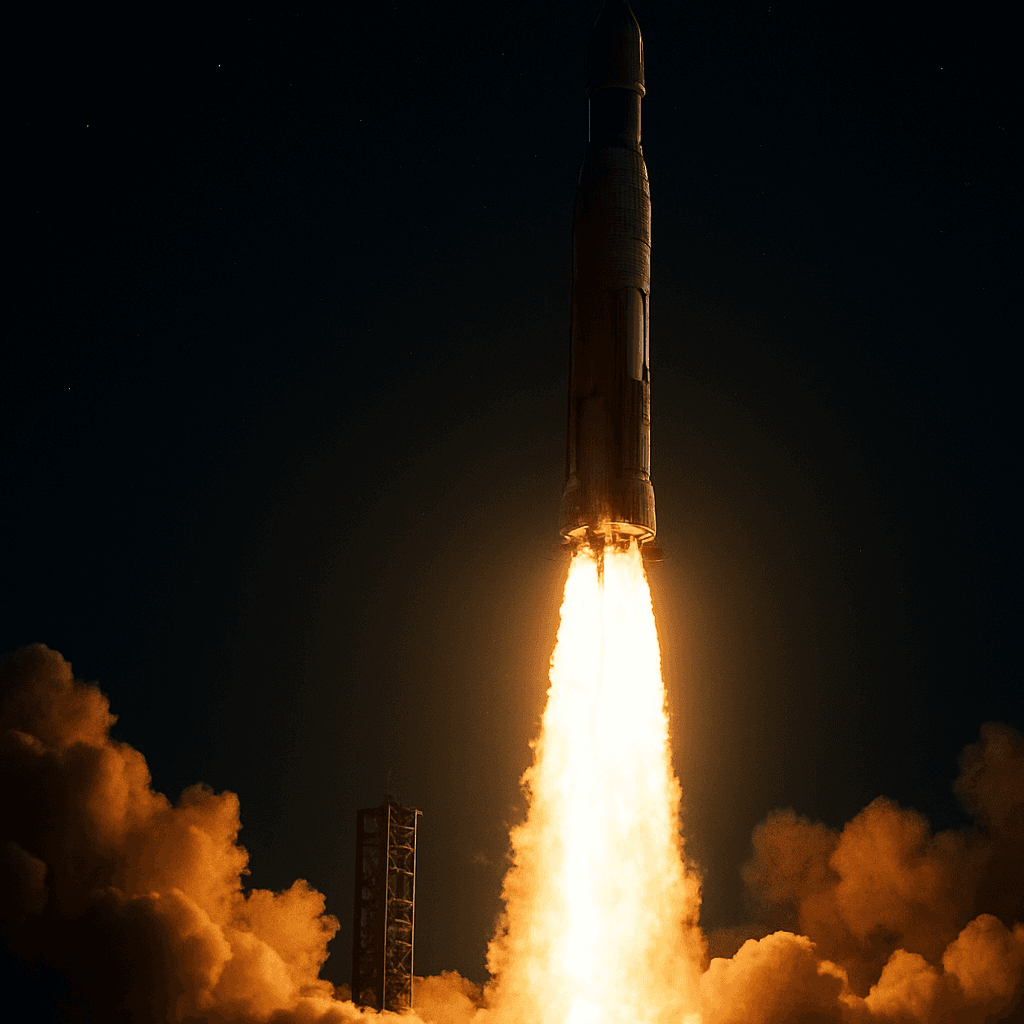
A Long March 7A carrying an unidentified payload failed after leaving Wenchang on Aug. 10. SpaceNews, relying on amateur footage, reported that the rocket exploded less than 90 seconds into flight and that the payload appeared lost. The immediate consequence is larger than one empty square on the manifest: until an official explanation arrives, the vehicle’s next missions carry a new reliability question.
Blue Origin found the part that failed
Blue Origin CEO Dave Limp attributed the May 28 New Glenn static-fire explosion to a main liquid-oxygen valve in one of the rocket’s seven BE-4 engines. Component tests and engine firings are shaping the fix. Naming the culprit is meaningful progress because corrective work can now be tested against a concrete failure mode; it is not, however, the same thing as proving the vehicle ready to return.
Webb made the image do scientific work
Webb used NIRCam and MIRI to observe NGC 2392, the Lion Nebula. Its infrared view separates compact dust clumps from a surrounding haze of ionized gas more clearly than Hubble’s earlier visible-light image, while showing material energized by the key white dwarf. That distinction is the result: astronomers received a better structural map, not merely fresh wallpaper.
H3 has its opportunity back
After postponement and successive schedule revisions, JAXA’s newest notice established an Aug. 10 window for H3 Flight 9 and the Michibiki 7 navigation satellite. The listed target is 19:23:31 UTC. This restores a real attempt to the calendar, but the distinction matters: an updated notice proves schedule recovery; launch and deployment must still prove mission recovery.
What changed
The week's meaningful movement.
A scheduled Long March 7A mission became the week’s clearest launch failure.
New Glenn’s investigation moved from an unexplained explosion to a named oxygen-valve fault.
Webb’s Lion Nebula observations resolved dust and ionized gas that visible light had blended together.
JAXA replaced QZS-7’s postponed state with a fresh H3 launch window.
Starlink 10-19 moved off its initial Cape Canaveral attempt after a scrub.
The week ahead
What to watch next.
| When | Watch item | Type |
|---|---|---|
| Aug 10, 2026, 12:02 PM | Long March 7A | Unknown Payload This calendar entry has already resolved as a reported launch failure; the next substantive development is an official account of what happened. | Launch |
| Aug 10, 2026, 7:23 PM | H3-22 | Michibiki 7 (QZS-7) JAXA’s newest schedule notice restores the navigation mission to a specific window. Liftoff and spacecraft deployment remain the decisive proofs. | Launch |
| Aug 11, 2026, 2:26 PM | Falcon 9 Block 5 | Starlink Group 10-19 Outside reporting supplies the revised time after the Aug. 10 scrub. Countdown status and deployment confirmation are now the useful checks. | Launch |
| Aug 12, 2026, 2:00 AM | Falcon 9 Block 5 | Starlink Group 17-49 The Vandenberg listing remains provisional until SpaceX provides current range, weather and countdown confirmation. | Launch |
| Aug 15, 2026, 9:52 PM | Falcon 9 Block 5 | R-1 The mission is listed for Vandenberg, but its status remains to be confirmed; treat the time as a watch point, not a promise. | Launch |
| Aug 16, 2026, 1:12 AM | Falcon 9 Block 5 | Globalstar 2-R Mission 1 (x 9) The communications flight holds a Sunday listing from Cape Canaveral. A current SpaceX countdown update would firm up the date. | Launch |
| Schedule watch | A countdown update followed by launch, deployment confirmation or another schedule change. Starlink 10-19’s next update will show whether the scrub was a one-slot delay or the start of a longer hold. | Event |
| Schedule watch | Detailed scientific analysis or follow-up observations that connect the newly resolved features to the nebula’s structure and evolution. The next Lion Nebula result should explain more of the physics behind Webb’s newly separated structures. | Event |
Week timeline
The week, in order.
| Moment | Target | Why it matters |
|---|---|---|
| Smart Dragon 3 completes its flight | Aug 5, 2026, 2:38 AM | The OSE HS-01 and HS-02 Earth-science mission reached the successful column from Haiyang Oriental Spaceport. |
| BlueBird 11–13 reach orbit | Aug 5, 2026, 7:49 AM | Falcon 9 carried three Block 2 communications satellites away from Cape Canaveral. |
| New Glenn inquiry narrows to a valve | Aug 6, 2026, 3:42 PM | Blue Origin’s chief executive identified a main oxygen valve as the cause of the May test-stand blast. |
| Another California batch deploys | Aug 8, 2026, 4:35 PM | Starlink Group 17-38 put 24 satellites into orbit from Vandenberg, extending the California cadence without adding a larger surprise. |
| Long March attempt ends early | Aug 10, 2026, 12:02 PM | The Wenchang mission failed shortly after liftoff with its payload still publicly unidentified. |
| Infrared instruments dissect the Lion Nebula | Aug 10, 2026, 12:00 AM | NASA and ESA released Webb views that distinguish dense dusty knots from luminous ionized material. |
| Starlink 10-19 loses its first slot | Aug 10, 2026, 12:00 AM | The Cape Canaveral flight was scrubbed and reporting moved the next attempt to 10:26 a.m. EDT on Aug. 11. |
Uncertainty
What's still in flux.
No official Chinese failure statement appears in the available reporting, so the early Long March account remains attributed to SpaceNews and the footage it reviewed.
Launch Intelligence
The story keeps moving. Stay with it.
This issue connects the week's developments. The live dashboard keeps target times, watch links, and launch detail pages one tap away as the schedule shifts.